
National Estate Planning Awareness Week, observed October 19–25, 2026, follows August’s Make-A-Will Month. A reminder to make a will is good advice, of course, but a thoughtful estate plan often involves much more than a single document. Tahoe Truckee Community Foundation (TTCF) views this week as an open invitation to review your whole plan and confirm that every piece points toward the people, causes, and community you care about. That invitation remains open throughout the year.
Making a will is among the most important steps you can take for the people you love. For those who hope to protect Tahoe-Truckee for the future, however, a will is often only the first piece of a larger picture.
What does an estate plan include besides a will?
An estate plan includes every document and designation that determines how your assets pass at death: not only your will, but also any revocable trust and the beneficiary or “transfer on death” designations on accounts such as IRAs, retirement plans, and life insurance policies.
Some assets are distributed under a will or according to the terms of a revocable trust. Others, including IRAs, retirement plan accounts, life insurance policies, and certain financial accounts, pass directly to the person or organization named on that specific account, regardless of what a will says. When these documents do not work together, even a carefully prepared will can leave gaps in the legacy you intended.
How can I include Tahoe Truckee Community Foundation in my estate plan?
Donors commonly include TTCF by naming it as a beneficiary of a retirement account, leaving a specific dollar amount or a percentage of their estate through a will or trust, establishing a fund for causes they care about, or making an unrestricted gift. Many combine more than one approach.
Creating the legacy you envision requires thinking not only about who and what you want to support, but also about how particular assets will get there. Depending on your circumstances and goals, you and your estate planning advisors might consider the following approaches.
1. Naming TTCF as a beneficiary of a retirement account.
You can generally designate a charitable beneficiary to receive all or a percentage of an IRA or retirement account, including TTCF or one of our endowed or quasi-endowed funds, while leaving other assets to family members or other beneficiaries. Traditional retirement accounts are particularly worth discussing with your advisors because distributions that may be taxable to individual beneficiaries can generally be received by a qualified charitable organization, including TTCF, without the same income tax burden.
2. Leaving a specific dollar amount through your will or trust.
Perhaps you wish to leave $25,000, $100,000, or another amount to establish or add to a fund at TTCF. Your attorney can incorporate the appropriate language into your estate planning documents.
3. Leaving a percentage of your estate through your will or trust.
Instead of specifying a dollar amount, you might direct that a percentage of your estate pass to a charitable fund. A percentage gift can adjust along with the value of your estate over time.
4. Creating a fund to support favorite organizations or causes.
Your estate gift could establish or add to a designated fund benefiting an organization you care about, or a field-of-interest fund supporting an issue that has been meaningful to you, such as forests, housing, families, or first-generation college students.
5. Leaving a gift to meet changing community needs.
You might instead leave all or a percentage of your estate as an unrestricted gift to TTCF. This approach entrusts us to put charitable dollars to work where they can make an important difference in Tahoe-Truckee as community needs and opportunities change over time.
TTCF is prepared to help donors build a legacy through bequests, revocable living trusts, charitable remainder unitrusts, and charitable lead trusts, as well as gifts of cash, securities, life insurance, and retirement assets.
These approaches don’t have to stand alone. Charitable components of an estate plan might incorporate more than one document, beneficiary designation, asset, or type of fund to accomplish your goals. Setting up a charitable giving structure is especially important if you anticipate a business exit at some point in the future.
For these reasons, National Estate Planning Awareness Week is an opportunity to look at your entire estate plan and ask whether your documents and beneficiary designations work together to reflect the people, organizations, and community you want to support.
And the question is worth revisiting whenever your circumstances change. If charitable giving has been a significant part of your life, the TTCF team would be honored to help you think about how it can become part of your legacy, too. We can work alongside your attorney, CPA, and financial advisor to help you explore charitable options and determine which type of fund may best carry out your intentions, for your family and for the community we all love, for years and perhaps generations to come.
Donors who make a planned gift to TTCF can be confident that the gift will be responsibly invested and administered, that their intent will always be honored, and that it will make a difference in Tahoe-Truckee.
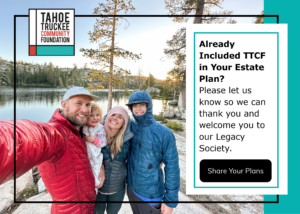
Donors who include TTCF in their will or estate plan are invited to join the Legacy Society, an honor society that recognizes those who have made a planned gift and brings members together for events and connection with neighbors who share their commitment to Tahoe-Truckee. If you have already included TTCF in your plans, we would be grateful to hear from you so that we can recognize your generosity.
To begin the conversation, explore Legacy Giving at TTCF or contact our team to schedule a meeting.
Frequently Asked Questions
Can I name Tahoe Truckee Community Foundation as the beneficiary of only part of my retirement account?
Yes. You can generally designate a charitable beneficiary to receive all or a percentage of an IRA or retirement account while leaving other assets to family members or other beneficiaries.
What language should my attorney use to include TTCF in my estate plan?
A simple bequest can be written as: “I give [an amount of money, shares of stock, a percentage of my estate] to Tahoe Truckee Community Foundation.” Your attorney will determine the precise wording that fits your plan.
Is charitable planning especially important if I expect to sell a business?
Yes. Setting up a charitable giving structure is especially important if you anticipate a business exit, and your attorney, CPA, and financial advisor can help determine the right approach and timing.
This article is provided for informational purposes only and is not intended as legal, accounting, or financial planning advice. Please consult your tax or legal advisor to learn how this information might apply to your own situation.
- Browse All Categories
Share this post
- Browse All Tags
- Achievable Housing
- Alpenglow Timber
- Behavioral Health
- Biochar
- Biomass
- Board Governance
- Board of Directors
- Building Resilience from the Forest Floor Up Series
- Business Philanthropy
- Cabin Creek Biomass Project
- CAL FRAME
- Collaborations
- Collective Impact
- Community Collaborative of Tahoe Truckee
- Community House
- Community Impact
- Community Resilience
- Community Wildfire Protection Plan
- Cross-Laminated Timber (CLT)
- Cultural Burning
- Defensible Space
- Economic Opportunity
- Education
- Emergency Preparedness
- Families
- Financial Stewardship
- Fire Resilience
- Fire-Resistant Construction
- Forest Futures
- Forest Futures Salon Series Winter/Spring 2025
- Forest Futures Scholarship
- Forest Restoration
- Forest Workforce
- Fundraising
- Give Back Tahoe
- Giving Tuesday
- Grant Cycle
- Grantmaking
- Home Hardening
- Housing
- Impact Investing
- Insurance
- Leadership
- Leadership Development
- Lunch and Learn
- Martis Fund
- Mass Timber
- Mental Health
- Mountain Housing Council
- National Forest Foundation
- Nonprofit Board Governance Series
- Nonprofit Leadership
- North Tahoe Biomass Task Force
- Northstar Energy Facility
- Partnerships
- Philanthropic Education
- Philanthropy
- Prescribed Fire
- Press Release
- Queen of Hearts Women's Fund
- Regenerative Economy
- Renewable Energy
- Scholarships
- Sierra Institute for Community and Environment
- Stewardship
- Strategic Planning
- Sustainability
- Sustainable Housing Solutions
- Tahoe50
- Training
- Volunteering
- Wildfire Insurance
- Wildfire Prevention
- Wildfire Resilience
- Women in Philanthropy
- Wood Innovations
- Workforce Development
- Workforce Scholarship Recipients 2025
- Workforce Scholarships
- Workshops
- Youth Development