
Protecting our community from wildfire requires more than a single project or property. It requires coordination, planning, sustained action (and sometimes patience) across the landscape.
Through a Wildfire Resilience Grant funded by the California Department of Forestry and Fire Protection, the Tahoe Truckee Community Foundation (TTCF) piloted a multi-year approach in which individual landowners, HOAs, and nonprofits across the region came together to develop forest management plans and reduce fuels in the areas identified as highest risk.
After three years, this work is now complete and represents a significant step forward in advancing TTCF’s Forest Futures Impact Strategy—protecting communities while stewarding forests through collaboration, technical expertise, and shared responsibility.
Together, these efforts made strides in forest stewardship and wildfire mitigation efforts in our region:
- 7 forest management plans were developed and completed
- 7 projects were completed
- 381 acres were treated, 7 of which were reforested.
From Awareness to Action
This project was designed to increase awareness, expand planning, and support on-the-ground implementation. In addition to reducing fuels, the work helped landowners understand their wildfire risk and how long-term forest management can meaningfully reduce it.
This approach reflects a core reality of wildfire in the Tahoe-Truckee region: the impacts are not confined to a single property. Wildfire risk is collective, and reducing that risk requires shared action.
Why Private Landowners Matter
A key component of this work was engaging private landowners, including organizations like HOAs and COAs. It’s natural to question why private landowners receive public funding. The answer lies in the nature of wildfire itself. Forest management is complex, costly, and wildfire does not stop at property lines. Helping landowners plan and manage their forests is essential to reducing long-term risk for surrounding communities.
More Than Fire Prevention: Stewardship for the Whole Ecosystem
When we talk about forest health, it’s easy to focus only on fire risk — and for good reason. But healthy forests are about more than reducing fuels. They’re home to wildlife, watershed systems, meadows, and streams that sustain the landscapes we love. When forests become overcrowded or stressed, those ecosystems suffer too.
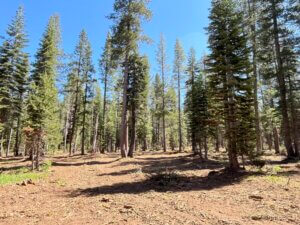
Thoughtful forest management means caring for the whole picture. Thinning overgrown treesallows sunlight to reach the forest floor, supporting native plants and the creatures that depend on them. Restoring meadows helps filter water and provide critical habitat. This is what true stewardship looks like— protecting structures, yes, and also investing in the living landscape that makes Tahoe-Truckee worth protecting in the first place.
As Lindsay Ryan, Assistant Forester at Tahoe Donner Association, puts it:
Stewardship is taking care of the land in a way that fosters a healthy ecosystem. When done thoughtfully, we can balance many types of land use while still improving the health of our forests, meadows, and streams.
A Collaborative, Community-Driven Process
Project sites were selected through a community-driven process led by a volunteer committee including partners from emergency services offices, fire protection districts, and nonprofits. Proposals were evaluated on multiple criteria:
- available data from community wildfire protection plans (CWPP),
- technical readiness,
- environmental compliance requirements,
- financial need, and
- geographic and applicant diversity.
Some property owners, such as Tahoe Donner Association or Olympic Valley Public Services District (OVPSD), have in-house forestry crews and experience with environmental permitting to lend to the process. Others, particularly volunteer-run associations, require significant technical assistance to move projects forward. Understanding and supporting these different needs was central to the program’s design.
That support was made possible by a substantial investment: the overall CAL FIRE award to TTCF totaled approximately $1.9 million, with about $1.7 million directed to landowners for forest management planning and implementation. Several projects also contributed matching dollars, significantly increasing the number of acres treated.
Lessons from the Field
One of the most important takeaways was the scale of demand for technical assistance. Forest management doesn’t begin with a chainsaw — it begins with a plan. Before any on-the-ground work can begin, landowners must work with a registered professional forester to develop a management plan and then navigate environmental permitting and compliance. That process takes time, expertise, and resources that many landowners — especially volunteer-run associations — simply don’t have on hand.
The demand for that kind of support was significant. Technical assistance funding was nearly exhausted in the first round of applications alone, signaling that the regional need to help communities understand forest management, navigate compliance, and prepare for implementation far outweighs the resources currently available. These insights are directly informing TTCF’s Forest Futures efforts and expanding the dialogue about how best to support private landowners over the long term.
The work also reinforced how deeply grantee capacity influences project success — organizations with staff, tools, and experience can move quickly, while volunteer-run groups require more support.
One of the clearest lessons? No one can do this alone. That spirit of shared learning is exactly what makes this region’s approach to wildfire resilience different — and what gives us reason for hope.
My advice would be to reach out to others who have done this work. There are numerous knowledgeable land managers in our community. We should share experiences and learn from each other so we can all do a better job going forward.
-Lindsay Ryan, Assistant Forester, Tahoe Donner Association
What This Work Made Possible
Perhaps the most encouraging outcome of this pilot isn’t measured in acres alone; it’s measured in what it unlocked.
Sugar Bowl Ski Resort, one of the program’s key partners, has used the lessons from this work to develop its own long-term stewardship program on the property, including exploring a biomass facility — a model others in the region can look to. To learn more, read about our new partnership.
Several grantee communities that developed Forest Management Plans through this program have since leveraged that work to apply for and secure additional funding, including Measure T grants through the Truckee Fire Protection District. Olympic Valley Public Services District secured additional funds from the Truckee Tahoe Airport District to expand the scale and impact of its efforts. And Truckee Donner Land Trust continues active stewardship and project management within Billy Mack Canyon, supported by additional resources from TTCF’s Forest Futures program.
This is what a pilot is supposed to do — prove what’s possible, build local capacity, and create a foundation that others can build on.
In 2022, the Olympic Valley Public Service District adopted the Olympic Valley Community Wild Fire Protection Plan, which identified five project areas needed to address fuel density and subsequent potential wildfire severity in Olympic Valley. We embarked on these aggressive fuels reduction efforts with little prior knowledge or history of this field and industry. TTCF engaged early and often with us and helped us navigate the myriad of steps including concept, planning, permitting, education and implementation. TTCF also helped secure funding early, which gave us recognition and paved the way for additional match funding. TTCF’s efforts contributed to over $445,000 of project funding. We are very grateful for TTCF’s support and involved in our efforts to provide a safer and more wildfire resilient community.
-Brad Chisholm, Fire Chief, Olympic Valley Fire Department
Forest Futures in Action
This CAL FIRE grant reflects TTCF’s Forest Futures Impact Strategy in action—protecting communities at highest risk and stewarding forests through coordinated, region-wide efforts. TTCF stepped in as a convener and administrator, working in close partnership with fire districts, public agencies, nonprofits, and landowners.
At its core, this work demonstrates what is possible when partners come together around a shared understanding of risk and responsibility. Wildfire impacts everyone, and meaningful progress requires layered/braided resources and collaboration.
Healthy forests are more than firebreaks — they’re home to the wildlife, water, and wild places that define life in Tahoe-Truckee. When we invest in them together, we’re not just reducing risk, we’re protecting the place we love. That’s what continues to guide TTCF’s Forest Futures work — and why expanding dialog and partnerships matters so much.
- Browse All Categories
Share this post
- Browse All Tags
- Achievable Housing
- Alpenglow Timber
- Behavioral Health
- Biochar
- Biomass
- Board Governance
- Board of Directors
- Building Resilience from the Forest Floor Up Series
- Business Philanthropy
- Cabin Creek Biomass Project
- CAL FRAME
- Collaborations
- Collective Impact
- Community Collaborative of Tahoe Truckee
- Community House
- Community Impact
- Community Resilience
- Community Wildfire Protection Plan
- Cross-Laminated Timber (CLT)
- Cultural Burning
- Defensible Space
- Economic Opportunity
- Education
- Emergency Preparedness
- Families
- Financial Stewardship
- Fire Resilience
- Fire-Resistant Construction
- Forest Futures
- Forest Futures Salon Series Winter/Spring 2025
- Forest Futures Scholarship
- Forest Restoration
- Forest Workforce
- Fundraising
- Give Back Tahoe
- Giving Tuesday
- Grant Cycle
- Grantmaking
- Home Hardening
- Housing
- Impact Investing
- Insurance
- Leadership
- Leadership Development
- Lunch and Learn
- Martis Fund
- Mass Timber
- Mental Health
- Mountain Housing Council
- National Forest Foundation
- Nonprofit Board Governance Series
- Nonprofit Leadership
- North Tahoe Biomass Task Force
- Northstar Energy Facility
- Partnerships
- Philanthropic Education
- Philanthropy
- Prescribed Fire
- Press Release
- Queen of Hearts Women's Fund
- Regenerative Economy
- Renewable Energy
- Scholarships
- Sierra Institute for Community and Environment
- Stewardship
- Strategic Planning
- Sustainability
- Sustainable Housing Solutions
- Tahoe50
- Training
- Volunteering
- Wildfire Insurance
- Wildfire Prevention
- Wildfire Resilience
- Women in Philanthropy
- Wood Innovations
- Workforce Development
- Workforce Scholarship Recipients 2025
- Workforce Scholarships
- Workshops
- Youth Development