
How one full-time hire at North Tahoe Fire is helping reshape wildfire readiness across the region — and what it reveals about the future of forest and fire careers.
April Shackelford didn’t set out to become a case study in workforce development. She set out to keep her community safe — one inspection, one conversation, one cleared brush pile at a time. But three years into a partnership with Tahoe Truckee Community Foundation (TTCF), North Tahoe Fire’s defensible space program has become something more. It is a working example of what it takes to build a wildfire workforce that actually lasts.
As Forest Fuels Manager, April has spent years trying to grow and improve North Tahoe Fire’s Forest Fuels and Defensible Space Program. It quickly became clear that the region’s wildfire focus had to stretch beyond one season at a time. When the region’s short-term rental program moved to require a defensible space inspection for every rental permit issued, the fire district was handed a mandate. Inspections had to happen, but there was no dedicated budget to hire anyone to do them.
Our jobs are protecting this district through educating homeowners about making the right choices with defensible space, home hardening, and evacuation preparedness. That gives me a reason to get out of bed in the morning. – April Shackelford, Forest Fuels Manager, North Tahoe Fire District
Wildfire Mitigation Work is No Longer “Seasonal” in California
The district’s first attempts to staff this work didn’t stick. Over several years, North Tahoe Fire brought on a handful of seasonal hires, but turnover was constant. People moved on for a position that could offer more stability. “Most seasonal staff don’t really want to be seasonal,” April explained. By the time someone was fully trained, the season — often stretching five, six, even nine months in Tahoe — was already ending, and the district was forced to recruit new hires the following year.
It’s a pattern Sache Cantu, TTCF’s Chief Operating Officer, has seen play out across the region: “The work required to keep communities safe is truly a year-round effort. This represents a shift in our community’s approach to preparedness and increasing wildfire resilience on the whole, it is no longer just seasonal work. The risk/threat of wildfire is an ever-present one.”
North Tahoe Fire’s First Community Specialist Connects Defensible Space to a Bigger Why
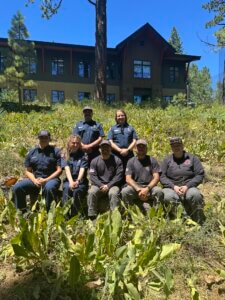
That shift in thinking is exactly what led North Tahoe Fire and TTCF to try something different: build one full-time, year-round role and invest in the person who fills it. That person turned out to be Michael Haran — who is local to the district, and, in April’s words, unusually willing to do the hardest part of the job: talk to homeowners.
“It’s hard to find somebody who wants to go talk to Joe and Susie homeowner about defensible space and the storage of combustibles around their home, while simultaneously trying to use the situation to build community,” April said. Michael grew up attending both Incline Village and North Tahoe High School, which means when he shows up at a resident’s door, he’s not a stranger representing a government agency. He’s a neighbor.
Defensible space compliance isn’t primarily a technical problem — it’s a relational one. April and Michael work to support a community-driven effort for wildfire preparedness. “The more you can hit that emotional chord with people,” she said, “the more it moves them to take action. Building out defensible space and home hardening structures shows respect for the loss we’ve already endured with wildfire in the region and shows we are prepared for the real threat that persists.“
But finding the right person was only half the equation. April is candid that retention depends just as much on how a person is managed as who they are. Her relationship with Michael has laid the foundation of a strong team — one where she works to avoid putting herself “above him” despite the age and experience gap, and where responsibility is real, not symbolic. “Our jobs are protecting this district through educating homeowners about making the right choices with defensible space, home hardening, and evacuation preparedness,” April said. “That does give me a reason to get out of bed in the morning” — and it’s a sense of purpose she’s worked to pass on, not just assign. With Michael handling the majority of these responsibilities, April can better focus on program funding and fuels reduction projects that are helping protect the community.
What Fire Mitigation Success Actually Looks Like
The numbers back up the story — and they matter beyond North Tahoe Fire’s boundaries, in a state facing a well-documented shortage of forest and fire-related workers. Since North Tahoe Fire hired a full-time Community Specialist:
- 4x the number of defensible space inspections have been completed annually — from 1,075 in 2022 to 4,947 in 2024.
- ~70% of the district are now Firewise-recognized communities, growing from 13 to 42 in the same window
Full compliance hasn’t risen at the same rate as inspections — but notable improvements are seen consistently and far more residents now understand exactly what needs to change.
Community Foundations Make Projects Pencil
It’s a fair question, and Saché doesn’t dodge it: why would a private philanthropy grant to a publicly-funded agency at all?
Public agencies often face heavy restrictions on the dollars they receive, and there are real, unfunded capacity gaps we can fill flexibly. This work is mission-critical to public safety in our region, and California as a whole is facing severe workforce shortages in forest and fire-related careers. -Saché Cantu, Chief Operating Officer, Tahoe Truckee Community Foundation
That flexibility includes covering the unglamorous costs that make a real job possible — a uniform, a cell phone bill, business cards — expenses so small next to a multi-million-dollar grant portfolio that most funders would call them “disallowable.” TTCF calls them essential. When one of the district’s wood chippers failed to meet air quality standards, TTCF funding helped the district purchase a replacement outright rather than lease one year after year, saving money long-term and freeing up staff time. And when the original grant timeline ran into the same seasonal hiring struggles it was meant to solve, TTCF extended it — redirecting remaining funds toward staff training and certifications instead of walking away.
“There is more than one path to an intended outcome and April and team have allowed TTCF to be partners in solving challenges and removing real-time barriers along the way.,” Saché said. One retained full-time hire is still a huge win. It’s a philosophy that treats grantmaking as a genuine partnership rather than a transaction — one where success is defined by impact, not by whether the original plan survived contact with reality.
A Replicable Wildfire Solution for the Mountain West
North Tahoe Fire isn’t the only district facing this challenge, and TTCF doesn’t pretend to have solved it region-wide. That’s the point of telling this story: to show what’s possible when funders stay flexible, a district is willing to be honest about what isn’t working, and the right person is given the room — and the support — to grow into a role the community actually needs.
Back at North Tahoe Fire, April is characteristically pragmatic about what that’s meant so far. “There’s so much more positive than negative,” she said. “The negative needs to be addressed, but the positive needs to be celebrated.” It’s a fitting note for a model built to spread: for North Tahoe Fire, and for the neighborhoods it protects, this is what readiness looks like — not a season of preparation, but a community built to withstand whatever comes next, and a blueprint other districts across the Mountain West can put to use.
Know someone who’s talked about a career in fire service?
The Lake Tahoe Community College Fire Academy trains the next generation of fire professionals right here in our backyard — share this with the person in your life who’s got what it takes. Learn more about the Fire Academy →
- Browse All Categories
Share this post
- Browse All Tags
- Achievable Housing
- Alpenglow Timber
- Behavioral Health
- Biochar
- Biomass
- Board Governance
- Board of Directors
- Building Resilience from the Forest Floor Up Series
- Business Philanthropy
- Cabin Creek Biomass Project
- CAL FRAME
- Collaborations
- Collective Impact
- Community Collaborative of Tahoe Truckee
- Community House
- Community Impact
- Community Resilience
- Community Wildfire Protection Plan
- Cross-Laminated Timber (CLT)
- Cultural Burning
- Defensible Space
- Economic Opportunity
- Education
- Emergency Preparedness
- Families
- Financial Stewardship
- Fire Resilience
- Fire-Resistant Construction
- Forest Futures
- Forest Futures Salon Series Winter/Spring 2025
- Forest Futures Scholarship
- Forest Restoration
- Forest Workforce
- Fundraising
- Give Back Tahoe
- Giving Tuesday
- Grant Cycle
- Grantmaking
- Home Hardening
- Housing
- Impact Investing
- Insurance
- Leadership
- Leadership Development
- Lunch and Learn
- Martis Fund
- Mass Timber
- Mental Health
- Mountain Housing Council
- National Forest Foundation
- Nonprofit Board Governance Series
- Nonprofit Leadership
- North Tahoe Biomass Task Force
- Northstar Energy Facility
- Partnerships
- Philanthropic Education
- Philanthropy
- Prescribed Fire
- Press Release
- Queen of Hearts Women's Fund
- Regenerative Economy
- Renewable Energy
- Scholarships
- Sierra Institute for Community and Environment
- Stewardship
- Strategic Planning
- Sustainability
- Sustainable Housing Solutions
- Tahoe50
- Training
- Volunteering
- Wildfire Insurance
- Wildfire Prevention
- Wildfire Resilience
- Women in Philanthropy
- Wood Innovations
- Workforce Development
- Workforce Scholarship Recipients 2025
- Workforce Scholarships
- Workshops
- Youth Development