


By Stacy Caldwell, Chief Executive Officer, Tahoe Truckee Community Foundation
I deeply believe that those closest to the problem are closest to the solution. This is a natural conclusion for anyone who has worked to address community-level challenges.
Community foundations focus on the most pressing issues of the people and places they serve. For all of us, that has meant achievable workforce housing, meeting community members’ needs, and addressing climate-related impacts on forest health and catastrophic wildfires. Solving these challenges requires interconnected, future-proof solutions.
This summer, TTCF hosted a Forest-to-Housing bus tour for eight State Agencies and our regional co-funders. This gave us the opportunity to showcase the solutions we have been developing for more than a decade with our regional partners. The portfolio is elegant, even though community work is complex, dynamic, expensive, and often political. Yet, our time with the dignitaries gave us the opportunity to learn from them and put new words to our work.
The Forest-to-Housing Bus Tour
The two-day gathering featured regional businesses, nonprofits, and government partners that are focused on delivering climate-resilient solutions for forested communities. These solutions take hazardous woody biomass from our overcrowded forests and turn it into regenerative building materials and energy: a small-diameter sawmill and cross-laminated timber operations headed up by Alpenglow Timber in Truckee, a cross-laminated timber factory in Taylorsville led by Sierra Institute for Community and Environment (Sierra Institute) and operated by Mosaic Timber, and a biomass boiler to generate neighborhood-level heat at Northstar through the Northstar Community Services District.
These projects have government-approved plans and permits, millions of dollars in committed public and private investment, and business models that rethink our local dependence on imported building materials and energy sources. These forest-to-housing solutions also have the potential to drive down energy and insurance costs, making housing more affordable for this and future generations.
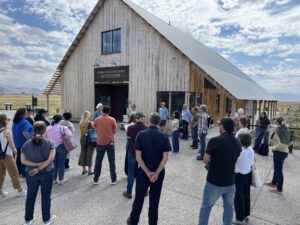
Solutions do not exist solely as blueprints and bone-dry tons. At the Feather River Land Trust’s Sierra Valley Preserve Nature Center, we took in the vast beauty of the dynamic wetland meadow that is home to the greatest diversity and abundance of birds in the Sierra Nevada. We learned about the Sierra Nevada’s diverse flora and fauna and met the professionals who spend their lives advocating for and protecting these wild places.
We also visited the Roundhouse Council Indian Education Center, home to the Mountain Maidu in Greenville. The Roundhouse sits at the center of the recovery efforts in Greenville after the Dixie and Beckwourth Complex Fires, and was one of the first buildings that was rebuilt- in cross-laminated timber.
TTCF’s Unique Role
TTCF highlighted the unique role of our Community Foundation as a source of flexible, nimble capital to help leverage other financial resources to make these projects “pencil.” TTCF has spent the last six years engaging our donors in our Forest Futures work and is roughly $10 million shy of our original $30 million goal for Forest Futures. To support these forest-to-housing solutions, we have created a woody biomass bundle within the Forest Futures Impact Portfolio. Within this portfolio, we have structured program-related investments for working capital, bridge funds, and soon-to-be equity investments. By approaching our investments this way, we can ensure regenerative capital that will continue to serve this region’s needs for years to come.
Aligning State and Local Leaders for On-the-Ground Solutions
The challenges we face might not be unique when we talk about issue areas like the need for healthcare, mental health supports, access to housing, and protecting the environment, but the way we approach solutions is. Communities have on-the-ground realities that inform their leaders, strategies, and resources. State representatives challenged TTCF to consider how the State might incorporate lessons from our efforts. Here is what we said:
Develop Trust-based Partnerships – Community-level solutions take many years and many sources of funds. State agencies can define what trust looks like in local project partners. Trust-based indicators can be tied to greater flexibility such as multi-year commitments and streamlined application processes.
Leverage Community Philanthropy – Philanthropy often serves as flexible, catalytic capital to demonstrate local-level solutions. Community Foundations are unique, trusted philanthropic intermediaries that fund a broad range of community issues and have strong ties to the local partners and projects seeking public dollars. Working intentionally with local-level philanthropy brings local expertise and leverages funding.
Align Funding. Align Impact. – Siloed funding reserved for specific issue areas such as housing, mental health, food assistance, or environmental resilience is not only creating administrative waste at both the local and state levels, but even worse, it doesn’t acknowledge the interconnected realities of local-level issues. A subsidy from one agency can create new demands on the local systems that need additional subsidy from a different agency. Develop Co-Impact funding strategies that bundle funding across agencies for one project. Collaborative application and funding processes could streamline the burden for everyone.
Develop Locally-Dialed Policy – Recognize that there are important differences in the size of communities and economic realities, often not captured at state and federal levels. Consider allowing “dials” at the local level for input on formulas that dictate eligibility and qualifications. Look for opportunities to embed flexibility in fund implementation to align with local-level jurisdictional intelligence.
To learn more about our community impact and how you can partner with us to make a difference, contact us at donorservices@ttcf.net.
- Browse All Categories
Share this post
- Browse All Tags
- Achievable Housing
- Alpenglow Timber
- Behavioral Health
- Biochar
- Biomass
- Board Governance
- Board of Directors
- Building Resilience from the Forest Floor Up Series
- Business Philanthropy
- Cabin Creek Biomass Project
- CAL FRAME
- Collaborations
- Collective Impact
- Community Collaborative of Tahoe Truckee
- Community House
- Community Impact
- Community Resilience
- Community Wildfire Protection Plan
- Cross-Laminated Timber (CLT)
- Cultural Burning
- Defensible Space
- Economic Opportunity
- Education
- Emergency Preparedness
- Families
- Financial Stewardship
- Fire Resilience
- Fire-Resistant Construction
- Forest Futures
- Forest Futures Salon Series Winter/Spring 2025
- Forest Futures Scholarship
- Forest Restoration
- Forest Workforce
- Fundraising
- Give Back Tahoe
- Giving Tuesday
- Grant Cycle
- Grantmaking
- Home Hardening
- Housing
- Impact Investing
- Insurance
- Leadership
- Leadership Development
- Lunch and Learn
- Martis Fund
- Mass Timber
- Mental Health
- Mountain Housing Council
- National Forest Foundation
- Nonprofit Board Governance Series
- Nonprofit Leadership
- North Tahoe Biomass Task Force
- Northstar Energy Facility
- Partnerships
- Philanthropic Education
- Philanthropy
- Prescribed Fire
- Press Release
- Queen of Hearts Women's Fund
- Regenerative Economy
- Renewable Energy
- Scholarships
- Sierra Institute for Community and Environment
- Stewardship
- Strategic Planning
- Sustainability
- Sustainable Housing Solutions
- Tahoe50
- Tax Strategy
- Training
- Volunteering
- Wildfire Insurance
- Wildfire Prevention
- Wildfire Resilience
- Women in Philanthropy
- Wood Innovations
- Workforce Development
- Workforce Scholarship Recipients 2025
- Workforce Scholarships
- Workshops
- Youth Development