


Years after Tahoe Truckee Community Foundation (TTCF) convened the Mountain Housing Council, its partners are creating new housing tools for our region. This August, they showed California’s top housing leaders how they did it.
In late 2018, four local district leaders started talking during a break at a Mountain Housing Council meeting. They asked whether they could work together to house their own employees. The Council was the regional housing table that TTCF convened and facilitated. After a year of brainstorming, that side conversation became the Truckee Tahoe Workforce Housing Agency, California’s first housing joint powers authority.
That moment says a lot about what the council made possible. It brought partners together under a shared collective impact model working from the same local data towards the same shared outcomes and with a spirit of collaboration. The ideas seeded during that time have grown into lasting solutions and continue to evolve as our community does. This August, TTCF brought the Mountain Housing Council partners back together, this time with leaders from eight California state agencies in the room.
The Council’s Legacy and Intentional Handoff
From 2017 to 2023, TTCF committed staff and resources to leading the Mountain Housing Council. The council brought 29 partners from local government, business, nonprofits, and philanthropy together around five shared priorities. Their shared goal was to accelerate achievable housing: homes that the community members who live and work in Tahoe Truckee can afford.
Before the council, the region understood its housing crisis mostly through anecdotes. The council replaced anecdotes with regional housing needs assessments, shared data, and 24 quarterly meetings. Over its run, partners:
- Facilitated 770 achievable housing units
- Attracted and invested $80 million in North Tahoe–Truckee
- Launched 15 programs
- Created 3 social enterprises
TTCF always designed the council to hand off. The aim was to build lasting capacity among partners, then step back so they could lead.
The Mountain Housing Council laid the groundwork for our credibility as a region. Beyond that, it shifted the mindsets of key local decision-makers and transformed how we talk about housing, elevating the conversation toward local, sustainable solutions.
– Maeve Donovan, Director of Impact Portfolio, TTCF
On Barriers and Realities of Building Housing Solutions
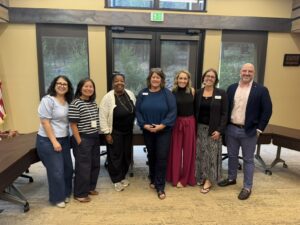
On August 14, council alumni gathered in Truckee for a roundtable on day two of TTCF’s Forest-to-Housing Tour. Tomiquia Moss, Secretary of the new California Housing and Homelessness Agency, opened with the very first briefing on the agency to a regional audience. She then opened the floor for an interactive discussion during which locals and State representatives alike spoke candidly about the goals, objectives, and hurdles they face when developing housing solutions.
 Devin Middlebrook of the Tahoe Regional Planning Agency (TRPA) then shared regional data gathered through TTCF and TRPA’s joint Regional Housing Needs Assessment, the first to encapsulate North Tahoe-Truckee and the entire Lake Tahoe Basin. What is most striking as a resort mountain community is that for a family to purchase a median-priced single-family home in this region, they need to make 245% – 255% of Area Median Income* (AMI).
What Tahoe Housing Partners are Building Now
Five partners then each gave a lightning talk on how they’re making housing work:
- Tyler Barrington, Director of Housing and Community Services, Nevada County
- Lynn Baumgartner, Housing Division, Town of Truckee
- Tim Cussen, Tahoe Housing Specialist, Placer County
- Heidi Volkhardt Allstead, Executive Director, Truckee Tahoe Workforce Housing Agency
- Erin Casey, President and CEO, Tahoe Housing Hub and Tahoe Housing Trust
The big takeaway: there’s no single silver bullet.
Our region’s partners are using many tools at once.
- Opening up existing homes. The Town of Truckee’s Lease to Locals, Rooted Renters, and Truckee Home Access programs help turn existing homes into housing for local workers.
 Building new homes. Placer County’s Launchpad grants and the Tahoe Housing Hub’s ADU Accelerator help build new units, including accessory dwelling units (ADUs) like backyard cottages. Truckee’s short-term rental workforce housing tokens reward owners who create new local housing.
- Making projects feasible. TRPA’s updated height, density, and coverage standards make it easier to build deed-restricted homes reserved for people who work locally.
- Financing what’s next. Partners are developing new regional financing tools, described below.
What Comes Next, and TTCF’s Role
At the afternoon session at Northstar Community Service District, housing partners held two working sessions on tools the region doesn’t yet have. Both are led by organizations TTCF helped build.
- A rural housing finance authority. The Truckee Tahoe Workforce Housing Agency is working to become California’s first rural regional housing finance authority. TTCF supported the agency’s formation and continues as an advisor. Next, the agency will represent our region at an invitation-only convening in Oakland to help shape public financing tools and speak for rural workforce housing statewide.
- A regional housing trust. The Tahoe Housing Hub, which TTCF seed-funded, is exploring a Tahoe Truckee housing trust.
Both efforts combine advocacy, direct service, and cross-sector collaboration. Both adapt state and regional housing innovations to fit a rural community’s needs.
Finally, the tour ended with a private visit to Truckee’s first year-round homelessness Navigation Center for Kim Johnson, California Secretary of Health and Human Services; and Secretary Tomiquia Moss, Undersecretary Sasha Kergan, and Deputy Secretaries Annie Carney and Christina Mun from the California Housing and Homelessness Agency. The visit offered an opportunity to explore the collaborative approach to homelessness led by the Tahoe Truckee Homelessness Action Committee (TTHAC). TTHAC developed the first regional action plan, with a goal of reaching functional zero, through a strategic planning process funded by TTCF.
Rural Housing Is Part of a Bigger Bioeconomy
Housing doesn’t stand alone. That’s why the roundtable was day two of a tour that began in the forest. On day one, state leaders saw forest-thinning byproducts becoming building materials at Alpenglow Timber and the Sierra Institute’s Wood Utilization Campus. They also saw the Maidu Tribe’s Roundhouse Indian Education Center built with Cross-Laminated Timber as part of the wildfire recovery efforts after the Dixie Fire. On day two, they saw Northstar Community Services District turning forest waste into heat for 13 buildings. Housing connects to forest health, energy, and workforce development in one regional bioeconomy.
State leaders told us they hope to see this kind of long-view, systems-based approach across California, and that they hadn’t yet seen it in action until this tour. TTCF makes it possible by playing four roles:
- Convener: Bringing public, private, and nonprofit partners to one table and keeping them there.
- Catalyst: Seeding new organizations like the Tahoe Housing Hub and supporting new ones like the Workforce Housing Agency.
- Connector: Bringing state leaders to see rural solutions firsthand and carrying rural voices to Sacramento.
- Systems thinker: Spotting where investments and systems fail to connect, and bringing partners together to close the gaps.
Explore TTCF’s Forest-to-Housing work and how we’re helping implement a regional bioeconomy.
- Browse All Categories
Share this post
- Browse All Tags
- Achievable Housing
- Alpenglow Timber
- Behavioral Health
- Biochar
- Biomass
- Board Governance
- Board of Directors
- Building Resilience from the Forest Floor Up Series
- Business Philanthropy
- Cabin Creek Biomass Project
- CAL FRAME
- Collaborations
- Collective Impact
- Community Collaborative of Tahoe Truckee
- Community House
- Community Impact
- Community Resilience
- Community Wildfire Protection Plan
- Cross-Laminated Timber (CLT)
- Cultural Burning
- Defensible Space
- Economic Opportunity
- Education
- Emergency Preparedness
- Families
- Financial Stewardship
- Fire Resilience
- Fire-Resistant Construction
- Forest Futures
- Forest Futures Salon Series Winter/Spring 2025
- Forest Futures Scholarship
- Forest Restoration
- Forest Workforce
- Fundraising
- Give Back Tahoe
- Giving Tuesday
- Grant Cycle
- Grantmaking
- Home Hardening
- Housing
- Impact Investing
- Insurance
- Leadership
- Leadership Development
- Lunch and Learn
- Martis Fund
- Mass Timber
- Mental Health
- Mountain Housing Council
- National Forest Foundation
- Nonprofit Board Governance Series
- Nonprofit Leadership
- North Tahoe Biomass Task Force
- Northstar Energy Facility
- Partnerships
- Philanthropic Education
- Philanthropy
- Prescribed Fire
- Press Release
- Queen of Hearts Women's Fund
- Regenerative Economy
- Renewable Energy
- Scholarships
- Sierra Institute for Community and Environment
- Stewardship
- Strategic Planning
- Sustainability
- Sustainable Housing Solutions
- Tahoe50
- Tax Strategy
- Training
- Volunteering
- Wildfire Insurance
- Wildfire Prevention
- Wildfire Resilience
- Women in Philanthropy
- Wood Innovations
- Workforce Development
- Workforce Scholarship Recipients 2025
- Workforce Scholarships
- Workshops
- Youth Development